
Get Money for a Car Your Alpharetta HOA Is Complaining About
A parking notice doesn’t automatically mean your car has no options. HOA rules vary by community, and some allow commercial or recreational vehicles in certain areas for only 24 hours. To get money for a car your Alpharetta HOA is complaining about, start by understanding which rule applies and whether selling the vehicle is the right way to resolve the parking problem.
It’s frustrating to receive an HOA warning while dealing with a damaged, unused, or extra vehicle. Separate the HOA’s parking restrictions from the car’s condition and value: a community rule may limit where or how long it can be parked, but it does not determine whether you can sell it.
This article explains which vehicles may be allowed, how common HOA parking rules can shape your choices, and what to consider if you decide to sell instead of keeping a vehicle that’s causing trouble.
Key Takeaways
- HOA parking rules vary by community, and some restrict where commercial or recreational vehicles can park or limit parking to 24 hours.
- Read the notice and governing rules to understand which vehicle, location, or condition prompted the complaint.
- If you need more time, explain your plan to repair or remove the car and ask the HOA for an extension before the stated deadline.
- If keeping the vehicle no longer makes sense, Windward Auto Removal Service buys junk, used, and totaled cars, as well as scrap trucks and SUVs.
Allowed vehicles
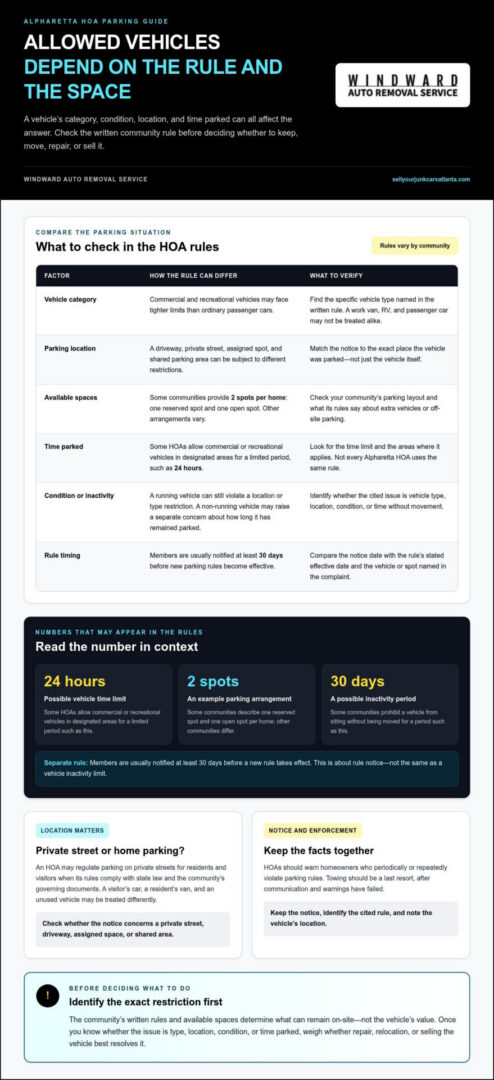
In Alpharetta, an HOA’s parking rules can depend on the development’s type, size, and available spaces. A vehicle that fits in a driveway may still be restricted on a private street or in a shared area. Read the community’s governing documents and the specific parking rule before deciding whether your car is allowed. The vehicle’s category, condition, location, and how long it remains parked can all affect the answer.
Commercial and recreational vehicles may face tighter limits than ordinary passenger cars. Some HOAs allow these vehicles in designated areas for a limited period, such as 24 hours. That limit can matter for a work van, RV, or other vehicle parked temporarily while loading or unloading. It doesn’t mean every Alpharetta HOA uses the same rule. Look for the vehicle type, permitted location, and time limit in the community’s written rules.
Parking capacity can also shape which vehicles are allowed. Some HOA communities provide 2 spots per home, described as one reserved spot and one open spot. Other communities may have different arrangements, depending on their layout and available parking. Where households have more than 2 vehicles, some communities expect extra vehicles to be parked off-site or on the street. That expectation depends on the rules and parking arrangement in that particular community.
Private streets are an important distinction. An HOA may regulate parking on private streets for residents and visitors when its rules comply with state law and the community’s governing documents. A visitor’s car, a resident’s van, and an unused vehicle may be treated differently. Check whether the complaint concerns a private street, driveway, assigned space, or shared parking area. The location helps identify the applicable restriction.
Written rules matter. HOA parking rules should be in writing, and members are usually notified at least 30 days before new rules become effective. Compare the notice date with the rule’s stated effective date, then match the rule to the vehicle and parking spot named in the complaint. If a notice refers broadly to “oversized vehicles,” for example, identify whether the restriction covers your specific vehicle category and where it is parked.
Consider parking eligibility separately from mechanical condition. A running car may still violate a location or vehicle-type restriction, while a non-running car may prompt a rule about how long it has been parked or whether it appears abandoned. For example, a damaged passenger car in a driveway raises different questions from a recreational vehicle on a private street. The written restriction, not the vehicle’s value, determines the parking issue.
Warnings and towing also affect how a parking complaint develops. HOAs should warn homeowners who periodically or repeatedly violate parking rules, since a resident may not realize a restriction applies. Towing should be a last resort, after communication and warnings have failed. If you receive a notice in Alpharetta, keep the letter, identify the cited rule, and note the vehicle’s location. Those details help you distinguish a correctable parking issue from a reason to remove the vehicle.
Before deciding whether to keep, move, or sell a vehicle, identify the exact restriction. A totaled car or work van may be covered by different parking provisions than a standard car. The community’s rules and available spaces determine what can remain on-site. Once you understand those limits, weigh whether repair, relocation, or selling the vehicle best resolves the issue.
A car that appears abandoned may raise a different concern from one restricted because of its type or location. When explaining the issue, identify the vehicle, where it was parked, and the rule you believe applies. If the dispute concerns permission to park, focus on the community’s written requirements and the facts of that parking situation. A concern about how the vehicle was advertised or sold is separate from an HOA parking issue.
The Federal Trade Commission says that, in the United States, complaints about deceptive car ads or dealers can be filed with a state consumer protection agency or the Federal Trade Commission. That option concerns deceptive advertising or dealers, not whether a particular vehicle is allowed in an HOA space. Before raising a complaint, describe the issue accurately and keep any relevant vehicle or parking information together. Separating a sales concern from a parking restriction can help direct each issue to the appropriate process without confusing the vehicle’s eligibility with how it was represented or sold.
How can I ask an HOA for more time to repair or remove a car?
Respond in writing as soon as you receive the HOA notice. Identify the vehicle, its parking location, the cited rule, and the notice’s deadline. Then explain whether you plan to repair, move, or remove the car. A specific plan gives the board a record of your response and is more useful than a general request for more time.
Read the notice closely before responding. Some HOAs limit how long a vehicle can remain parked outside a homeowner’s property to prevent abandoned vehicles. Some communities prohibit a vehicle from sitting without being moved for a period such as 30 days. If your notice concerns a vehicle that hasn’t moved, explain its current status and the specific action you’ll take. If the notice cites another rule, address that rule rather than assuming the issue is inactivity.
Give the HOA a realistic reason for needing an extension. For a repair, describe the work that remains and what needs to happen before the car can be moved or made compliant. For removal, explain the arrangements you’re making and when you expect the vehicle to leave. Avoid promising a completion date you can’t meet. A precise, manageable request helps the board understand what you’re asking it to allow.
Include the key details in your written message:
- Identify the car and the location named in the notice.
- Refer to the HOA notice and its stated deadline.
- Explain whether the plan is repair, relocation, or removal.
- Ask for a specific extension and give the reason for it.
- Request written confirmation of the revised deadline or decision.
Some HOA residents have been given 30 days to comply after receiving notice of a parking-related violation. That example doesn’t establish a standard deadline for every Alpharetta community. Your notice and governing documents matter. Ask for an extension before the deadline, and don’t treat another community’s timeline as permission to leave your vehicle in place longer.
Keep your response factual, even if you believe the notice is mistaken. Explain why the car cannot be moved yet and request the time you need to complete the repair or removal. Attach relevant documentation, such as a repair appointment or written removal arrangement, if it supports your explanation. Keep a copy of your message and note when you sent it.
If the HOA replies with a shorter deadline, read it carefully and respond promptly. An HOA attorney’s follow-up letter may give a homeowner a short period, such as 7 calendar days, before vehicle removal. Treat a stated deadline seriously. If your plan can’t meet it, explain the obstacle and offer a practical alternative, such as moving the car to another permitted location while repair or removal is arranged.
Don’t assume silence means approval. If you receive no response, follow up in writing and keep the original request. Ask whether the extension has been granted and what deadline applies while the request is being considered. Keep communication focused on the vehicle, the rule, and your proposed resolution. Clear records help prevent confusion about the plan.
If repair no longer makes sense, removal may be the more practical route. Explore ways to remove an unwanted car while you communicate your timeline to the HOA. Whatever option you choose, make your request specific, document each response, and act within the deadline the HOA gives you.
Windward Auto Removal Service: Cash for Junk Cars
Windward Auto Removal Service buys junk, used, and totaled vehicles in Alpharetta, including scrap trucks, SUVs, vans, and fleet vehicles. If the HOA complaint concerns a vehicle you no longer want, selling it can be a practical alternative to keeping or repairing it. The company provides free towing and immediate cash payment at removal, helping you arrange to have the vehicle taken away while you continue communicating with the HOA about its deadline.
Consider the vehicle’s condition and your next step before deciding. A car that still has use may suit a different option than a totaled vehicle or scrap truck. For details about selling an unwanted vehicle, visit Windward Auto Removal Service or contact the company.
Make Your Next Move With Confidence
Once you’ve chosen what to do with the vehicle, keep your next move focused: follow through on your plan and keep the HOA communication clear. If you decide to sell, having the car’s basic details ready can help you start a focused conversation about your options. The goal is to resolve the parking problem without adding more uncertainty to your day.
If you’re ready to get money for the car your HOA is complaining about in Alpharetta, contact Windward Auto Removal Service to discuss selling it. You can take the next step at a pace that works for your situation, with the vehicle’s condition and your plans guiding the conversation. A clear decision can turn a stressful HOA issue into a practical path forward.
Contact Windward Auto Removal Service and move toward a solution that feels right for you.
Frequently Asked Questions
What HOA rules in Alpharetta can restrict a disabled, inoperable, or unregistered car?
Restrictions depend on each community’s governing documents, not on one uniform Alpharetta-wide HOA rule. A notice may concern a vehicle’s condition, registration, parking location, or how long it has remained stationary. Read the cited rule and identify the precise issue. If the notice does not make the concern clear, ask the HOA to explain it in writing before deciding what to do.
What low-cost towing, junk-car pickup, or vehicle donation options are available near Alpharetta?
For a vehicle you want to sell, Windward Auto Removal Service buys junk, used, and totaled cars, and offers “NO HIDDEN FEES PLUS FREE TOWING!” If you want to get money for the car your HOA is complaining about in Alpharetta, selling may fit better than donating, which gives up sale proceeds. Compare your goal, the vehicle’s condition, and whether you want cash or a charitable gift.