
Proof of a Junked Vehicle in Alpharetta: Georgia DDS Reference
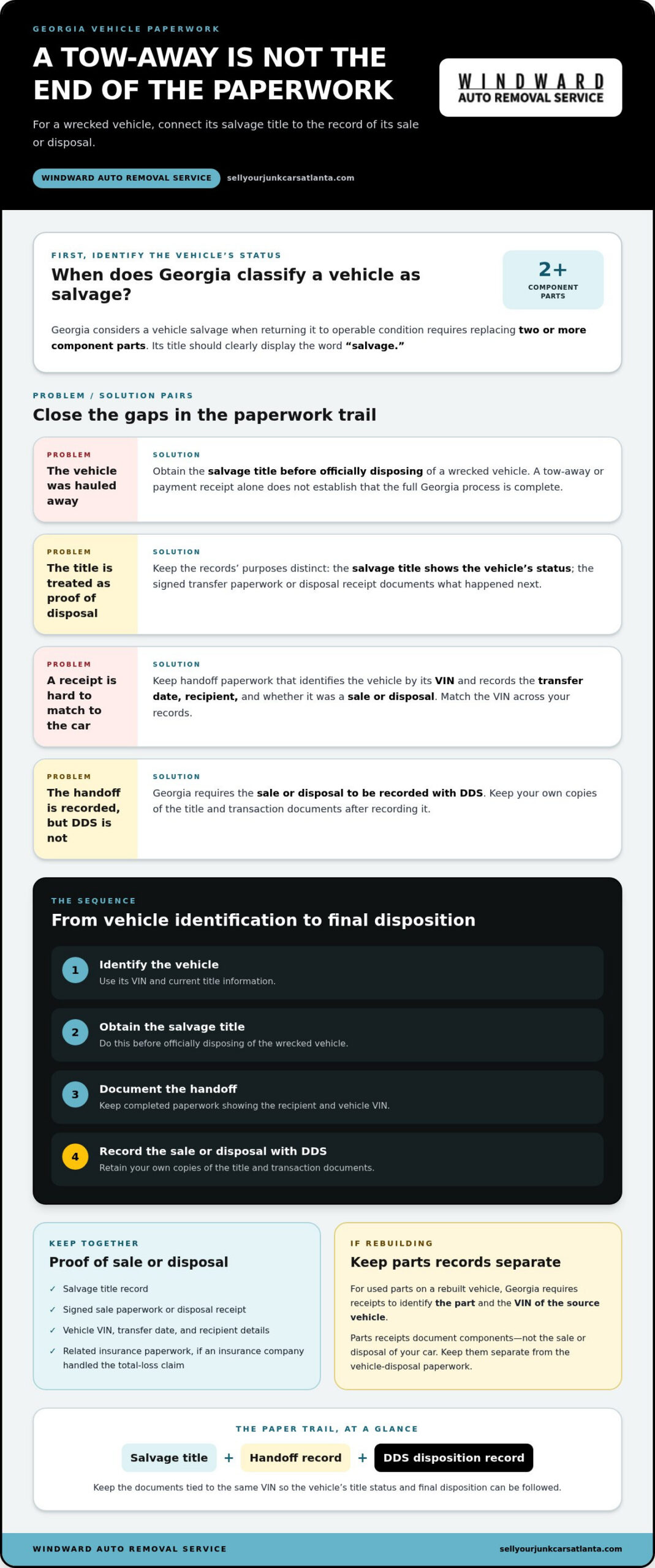
A wrecked car isn’t officially off your hands just because it has been hauled away. For proof of a junked vehicle for DMV Alpharetta records, the key Georgia steps are to obtain a salvage title before disposal and record the sale or disposal with DDS. Georgia considers a vehicle salvage when returning it to operable condition requires replacing two or more component parts.
A vehicle’s damaged condition and the paperwork documenting what happened to it are separate matters. This guide explains how Georgia defines a salvage vehicle, what a salvage title establishes, and how to record a sale or disposal. It also covers the different process for keeping a vehicle to rebuild, so you can choose the right next step and avoid treating the handoff as the whole job.
Key Takeaways
- Separate the paperwork for a vehicle’s sale or disposal from the steps required to keep and rebuild it.
- Know what records to retain from the vehicle handoff and what information can help document the transaction.
- Use the right process for a Fulton County tag-office matter, and identify when the DDS record needs attention.
- If a title or receipt is missing, focus on recovering the vehicle and transaction details needed to move forward.
- Recognize when Georgia classifies a vehicle as salvage and what that means before attempting to return it to the road.
What proof does Georgia DMV require that a vehicle was junked or scrapped?
A salvage title is Georgia’s official title record for a vehicle classified as salvage. Before officially disposing of a wrecked vehicle, obtain its salvage title and record the sale or disposal with DDS. A buyer’s receipt may help document the handoff, so keep it with your other vehicle records. For proof of junked vehicle for DMV Alpharetta records, keep each document tied to the vehicle’s VIN.
Salvage status describes a vehicle that needs substantial repairs to return to operable condition. In Georgia, a vehicle qualifies as salvage when restoring it requires replacing two or more component parts. The title should clearly display the word “salvage.” This branding identifies the vehicle’s title status; it isn’t a receipt showing that the vehicle was later sold or scrapped. Check the title before arranging a transfer or disposal.
Disposal or sale record documents what happened to a wrecked vehicle after its salvage status was established. Georgia requires the sale or disposal to be recorded by DDS. Keep a copy of the signed sale paperwork or disposal receipt with your records, along with the vehicle identification number (VIN), transfer date, and recipient details. These details connect your documents to the transaction and make proof of junked vehicle for DMV Alpharetta paperwork easier to follow.
Use this practical sequence for a wrecked vehicle in Alpharetta:
- Identify the vehicle using its VIN and current title information.
- Obtain the salvage title before officially disposing of the vehicle.
- When transferring it, keep completed paperwork showing the recipient and vehicle VIN.
- Record the sale or disposal with DDS, and retain your own copies of the title and transaction documents.
A receipt supports your records by showing that a transfer took place. Make sure it identifies the vehicle and the parties, and states whether the transaction was a sale or disposal. For example, a receipt that names a vehicle only by make and color may be harder to match to the title than one that includes its VIN. Treat the receipt as useful documentation, not a replacement for the required title and DDS record.
Proof of junking is the paperwork trail linking a salvage-titled vehicle to its final sale or disposal. Keep the salvage title record, signed handoff paperwork, and any receipt together. If an insurance company handled the total-loss claim, keep its related paperwork with those records. Each document has a distinct purpose: the title shows the vehicle’s status, while the transfer record documents what happened next.
For Alpharetta owners, a tow-away or payment receipt alone doesn’t establish that the full Georgia process is complete. Obtain the salvage title, document the handoff, and record the sale or disposal with DDS. Keep copies showing the same VIN so your records trace the vehicle from title status to final disposition.
What documents should an Alpharetta vehicle owner get from a junkyard or auto recycler?
A vehicle receipt is a transaction record that identifies the vehicle and documents its handoff. Ask for a dated written receipt showing the vehicle identification number (VIN), the business name, and whether the vehicle was purchased or accepted for disposal. Keep the original or a clear copy with your title records. For example, a receipt listing only “blue sedan” may not clearly identify the vehicle connected to your Georgia paperwork.
A sale or disposal confirmation records what happened to the vehicle after it left your possession. Request the transfer date, recipient’s name, and a description of the transaction. These details can help you match the handoff to your records if you later need to explain the vehicle’s disposition. The receipt documents the transaction; it doesn’t replace Georgia’s salvage-title process or the requirement to record a wrecked vehicle’s sale or disposal with DDS.
A title transfer record shows how ownership or title documents were handled during the handoff. If you give the buyer a title, retain a copy or note the title information and transfer details before handing it over. Match the VIN on the title to the VIN on the receipt. If the vehicle has salvage status, keep the salvage-title record with the transaction documents to connect its title history and disposition.
Before the vehicle leaves, compare the paperwork against this checklist:
- Vehicle identification: Confirm the VIN on the receipt matches the vehicle and its title.
- Transaction details: Make sure the document says whether it records a sale or disposal.
- Handoff information: Keep the date and recipient’s business name in your copy.
- Title record: Retain your title information and any paperwork documenting its transfer.
- Parts documentation: If you plan to rebuild the vehicle, keep receipts identifying used parts and the VIN of each parts vehicle.
A parts receipt identifies a component used in a rebuild and the vehicle it came from. Georgia requires receipts for used parts on a rebuilt vehicle to identify the part and the VIN of the source vehicle. This matters when a recycler supplies parts for a vehicle you plan to restore. Keep parts receipts separate from the vehicle-disposal receipt: they document parts, not the sale or disposal of your car.
Once you have the receipt and title records, keep them together and complete the DDS disposition step. If you’re selling a wrecked vehicle instead of rebuilding it, you can sell your wrecked vehicle and keep the transfer paperwork with your records.
What is the Fulton County tag office procedure for a junked vehicle near Alpharetta?
A tag office is a county office that handles vehicle title and registration matters. For a wrecked vehicle near Alpharetta, distinguish a local tag-office question from the required Georgia DDS record. The sale or disposal must be recorded with DDS, while salvage-title applications go to the Georgia Department of Revenue, Motor Vehicle Division, Salvage Unit. These steps serve different purposes.
A DDS disposition record documents that a wrecked vehicle was sold or disposed of. Keep the transaction paperwork, including the VIN and recipient details, so the vehicle can be identified. Don’t treat a tag-office visit or recycler’s receipt alone as proof that the DDS record is complete. The receipt documents the handoff; recording the sale or disposal with DDS is a separate step.
A salvage-title application requests the title record for a vehicle classified as salvage. Georgia’s application uses Form MV-1S, the Salvage Title Application. If you keep a vehicle after an insurance total-loss claim, confirm with your insurer what title paperwork is needed. The application requires the vehicle’s Georgia license plate and the original valid title, if available.
For the salvage-title application, submit the materials to the Georgia Department of Revenue, Motor Vehicle Division, Salvage Unit, at P. O. Box 740384, Atlanta, GA 30374-0384. That mailing address is for the Salvage Unit. It is not an instruction to send the application to a Fulton County tag office. Keep copies of the submitted documents and transaction records with the vehicle file.
Use this sequence to keep the two records straight:
- Identify the vehicle by its VIN and review its current title status.
- If the vehicle is salvage, assemble Form MV-1S, the Georgia license plate, and the original valid title if available.
- Send the salvage-title application to the Georgia DOR Salvage Unit at the Atlanta mailing address.
- After a wrecked vehicle is sold or disposed of, record that disposition with DDS.
- Retain copies of the title paperwork and handoff records together.
A county-office visit is useful when your task concerns a local title or registration matter, but it does not replace the DDS disposition step. For example, if you are asking about a wrecked vehicle’s sale, bring the transaction details and VIN when discussing the record. If your task is obtaining a salvage title, use the MV-1S process and Salvage Unit destination instead.
Alpharetta owners should match each agency to its purpose: DDS records the sale or disposal, and Georgia DOR’s Salvage Unit handles the salvage-title application. This distinction helps prevent a tag-office inquiry from being mistaken for proof that the wrecked vehicle’s disposition was recorded.
What should I do if I lost the title or junk receipt for a vehicle in Georgia
A lost title is a missing ownership document, not proof that a vehicle was sold or scrapped. First, identify whether the vehicle is still yours, was retained after an insurance total-loss claim, or was already transferred. Write down the VIN and gather any title copy, insurance paperwork, or transaction records you still have. For proof of junked vehicle for DMV Alpharetta records, identify which document is missing. This separates a title issue from a missing handoff receipt.
A salvage-title application is the Georgia process for obtaining a salvage title. Form MV-1S is the Salvage Title Application. If an insurance company declared the vehicle a total loss and you retained it, the insurer must apply for the salvage title in your name when the vehicle requires a title. The application requires the Georgia license plate and the original valid title if available. A missing title does not turn a receipt into a title.
If the insurer handled the claim, contact that insurer about the title paperwork and obtain copies of records tied to the claim. Keep the claim documents with the VIN and plate information. Georgia’s salvage-title application is submitted to the Department of Revenue, Motor Vehicle Division, Salvage Unit, at P. O. Box 740384, Atlanta, GA 30374-0384. This is the Salvage Unit mailing address, not a substitute for documenting a later sale or disposal.
A lost junk receipt is a missing record of the vehicle handoff. Contact the person or business that took the vehicle and request a copy of the transaction document. Ask for a record identifying the VIN, transfer date, recipient, and whether the vehicle was sold or disposed of. Compare these details with any insurance or title records. For example, a receipt showing the VIN can connect the handoff to the vehicle even if you no longer have a copy of the title.
Once you recover or reconstruct the transaction record, keep it with your remaining paperwork. Georgia requires a wrecked vehicle’s sale or disposal to be recorded by DDS. A receipt helps document the handoff, but it doesn’t replace the DDS record. For a clear proof of junked vehicle for DMV Alpharetta file, keep the receipt and DDS disposition information together. If the vehicle was never transferred, don’t describe a missing receipt as evidence of disposal.
A rebuilt-title file supports an application to title a repaired salvage vehicle. Georgia requires the original valid salvage title issued in the owner’s name or properly assigned to that owner. If the title is lost, organize the VIN, insurance documents, and any title copies before taking further steps. Keep the documents together, and separate parts receipts from the vehicle’s sale or disposal records.
Choose the next step based on the missing document: recover transaction paperwork if a receipt is lost, or organize title and insurance records if the title is missing. This keeps the vehicle’s ownership history distinct from its final disposition.
Salvage vehicles
A salvage vehicle needs two or more component parts replaced to return to operable condition. Georgia titles must clearly display “salvage.” This distinction matters: a damaged vehicle and a vehicle with a salvage title aren’t interchangeable descriptions. Check the title branding before deciding whether to rebuild, transfer, or dispose of the vehicle.
A salvage certificate of title documents the vehicle’s salvage status. A buyer who intends to operate, sell, transfer, or rebuild a salvage vehicle must apply for the certificate within 30 days of purchase. The Georgia salvage-title application uses Form MV-1S. If the vehicle requires a title and the owner keeps it after a total loss, the insurance company must apply for the salvage title in the owner’s name.
A licensed rebuilder is a person licensed in Georgia to purchase a salvage or wrecked vehicle for restoration or rebuilding. If you’re considering buying one to rebuild, check the licensing requirements first. This distinction matters to private owners considering repairs: keeping a wrecked vehicle after an insurance claim is different from purchasing one to rebuild.
A rebuilt title is the title issued after a salvage vehicle completes Georgia’s rebuilding and inspection process. Before applying, prepare the original valid salvage title, properly issued or assigned to the applicant. The application also requires completed and signed Form MV-1, Title/Tag Application, and Form T-129, Labor and Parts Certification. Used-parts receipts must identify each part and the VIN of its source vehicle.
For a salvage vehicle rebuilt from a Georgia salvage title, the owner must also prepare:
- One or more photographs showing the vehicle in salvage or wrecked condition before repairs.
- Completed and signed Form T-22R, Request for Inspection of a Rebuilt Motor Vehicle.
- The parts vehicle’s title, either on file with the Department or submitted with the application.
A rebuilt-vehicle inspection checks the repaired vehicle before it receives a rebuilt title. Georgia salvage vehicles cannot legally operate on public roads, so a salvage-titled vehicle being inspected must be towed to the inspection site. It must pass inspection before receiving a rebuilt title, and inspection must occur before the vehicle is painted. With a state inspector, the inspection and title fees total $118.
If rebuilding isn’t your plan, you can sell a totaled vehicle instead. Keep the title and transfer paperwork together, and record the sale or disposal with DDS.
Windward Auto Removal Service: Cash for Junk Cars
Windward Auto Removal Service helps vehicle owners who are ready to sell rather than rebuild. Its offerings include Cash for Junk Cars, Cash for Used Cars, Cash for Totaled Vehicles, and Cash for Scrap Trucks and SUVs. If a wrecked vehicle no longer makes sense to repair, selling it can be a practical alternative to pursuing a rebuilt title. Keep the title and sale records, and remember that the sale or disposal must still be recorded with DDS.
For a totaled car, scrap truck, or unwanted SUV, choose the option that fits the vehicle. To discuss selling your vehicle, contact Windward Auto Removal Service or visit sellyourjunkcarsatlanta.com.
Choose the Next Step That Fits Your Vehicle
With the paperwork gathered, decide whether to keep the vehicle, pursue a rebuild, or sell it. That choice determines your next steps, so keep your records accessible and use consistent vehicle details in any follow-up. For Alpharetta owners, clear proof of a junked vehicle for DMV records can make it easier to explain the vehicle’s status and disposition when needed.
If selling is the practical option, Windward Auto Removal Service buys junk, used, and totaled vehicles, including unwanted cars and trucks. The service can suit owners who don’t want to rebuild or keep an unwanted vehicle. Keep your transaction records with your vehicle documents as you move forward.
Ready to discuss selling your vehicle? Contact Windward Auto Removal Service and take the next step with confidence.
Frequently Asked Questions
How do I cancel a Georgia vehicle registration after junking the vehicle?
Record the wrecked vehicle’s sale or disposal with DDS, and keep the transaction record separate from registration paperwork. A receipt documents the handoff, while the DDS disposition record documents what happened to the vehicle. For example, retain the receipt showing the VIN and transfer date with your records. These documents serve different purposes, so don’t treat the buyer’s receipt as proof that the registration itself was canceled.
Do I need to surrender the license plate when junking a car in Georgia?
Keep the Georgia license plate available if the vehicle needs a salvage-title application, because the application requires it. A plate and a junk receipt serve different purposes: the plate is part of the salvage-title paperwork, while the receipt documents a handoff. Before disposing of the plate, organize the vehicle’s title and transaction records. This helps avoid losing an item needed for a salvage-title application and keeps the paperwork tied to the correct vehicle.
Where can I obtain a certificate of destruction or junk receipt in Georgia?
Request a written receipt from the person or business accepting the vehicle at handoff. Ask for the VIN, transfer date, recipient’s name, and whether the vehicle was sold or disposed of. Keep the receipt with your vehicle records. Georgia requires the disposal or sale of a wrecked vehicle to be recorded by the DDS, and a salvage title must be obtained before officially getting rid of it.
Does Georgia require notifying the county tag office when a vehicle is junked?
Georgia requires a wrecked vehicle’s sale or disposal to be recorded with DDS. That requirement is separate from a county tag-office inquiry about title or registration paperwork. For example, if your question concerns the vehicle’s final disposition, have the VIN and transaction record ready for the DDS process. A county-office interaction should not be treated as proof that the sale or disposal has been recorded with DDS.
Are there fees or deadlines for canceling registration after scrapping a vehicle in Georgia?
The 30-day deadline applies to a buyer applying for a salvage certificate after purchasing a salvage vehicle, if they intend to operate, sell, transfer, or rebuild it. It is not a stated registration-cancellation deadline. Rebuilding fees are separate: Georgia’s inspection and title fees total $118 when using a state inspector. Keep those rebuilding costs distinct from the records associated with a vehicle’s sale or disposal.
Can I use a bill of sale or towing receipt as proof that my car was junked in Georgia?
A bill of sale or towing receipt can support your records by documenting the handoff, especially if it includes the VIN, date, and recipient. It doesn’t replace the required DDS record of a wrecked vehicle’s sale or disposal. For example, a towing receipt may show that the vehicle was picked up, but the DDS disposition record documents what happened to it afterward. Keep both types of documentation together when available.